
Krechet lunar extravehicular space suit all photos courtesy Gary Kitmacher
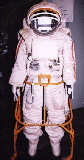 | Good overall frontal view of the Krechet suit from the front (12 o’clock) view. Note that the gold visor is up, and the chest-mounted control unit for the suit is swung up against the torso. Again we see the orange frame, used to hold the suit up for display, which some people have at times mistaken as part of the suit. |
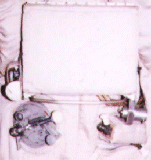 | Close-up from previous photo of the chest pack and some of the details from the torso of the Krechet suit. There are 2 sets of knobs to the left of the control unit, one of which is for locking and unlocking the opening on the backpack so the cosmonaut can climb in and out of the suit. There is also a small device under the control unit on the right. |
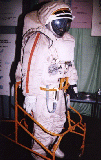 | 2 o’clock view of the suit. Note the tether at the waist, hooked onto the orange frame. This would have been used by the cosmonaut during his transfer EVAs between the LK and LOK vehicles before and after the landing. Also note the black palms of the gloves. |
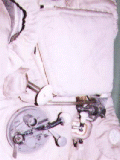 | Close-up from photo above, near the chest-mounted control unit. The white knob at left center was probably used to open and close the back of the suit. The gray, circular object at bottom left appears to be some kind of valve. You can also see part of the gray hinge mechanism for the control unit at right center, and a blurry view of the pressure gauge on the left arm of the suit in the background. A very similar very from a different photo set can be seen here. Click here for a good close-up of the pressure gauge. |
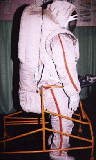 | Side shot from 3 o’clock position. You can see the seal around the back for the opening of the backpack, as well as the locking mechanism for it. |
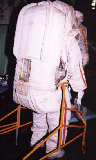 | Three quarter view from the right rear of the suit. The thermal blankets covering the backpack become apparent, as well as its massive size. Also, there is a good view of the backpack locking/unlocking mechanism (see below). |
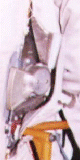 | Close-up of the backpack locking/unlocking mechanism, in this case in the locked/closed position. Compare with image below, and it is clearly evident how this operated. |
 | Rear view from 5 o’clock position. Even though this is reportedly the actual primary flight unit which Leonov would have worn on his mission, there are no emblems or flags mounted anywhere on the backpack or the suit. Compare this to another photo here, which clearly shows a Soviet crest sewn onto the chest-mounted control unit of another Krechet suit. There is a close-up of the small, rectangular object on the backpack below. |
 | Close-up of the small, rectangular object on the rear aspect of the backpack. On inspection, it appears to be an opening or aperture of some sort, covered by a small piece of black netting. |
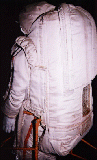 | View from the 7 o’clock position to the rear of the suit. The shadows provide good relief to the texture of the thermal blankets covering the backpack. |
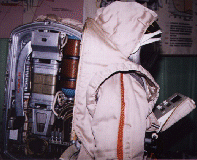 | Here the backpack has been swung open to show the life support system for the suit, and the chest-mounted control unit has been swung into the open position as it would have been when the cosmonaut needed to view the gauges or operate the controls. |
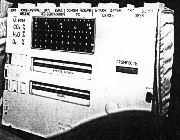 | B&W photo of the chest-mounted control unit. Another similar view of it can be seen here, and a diagram of the controls and displays with English translations for their meanings is here. |
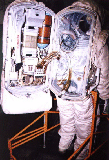 | 5 o’clock view of the open backpack, showing the life support equipment housed within. You can also begin to see the interior of the main part of the suit. |
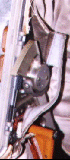 | Another close-up of the backpack locking/unlocking mechanism, in this case in the unlocked/opened position. Compare with image above, and it is clearly evident how this operated. |
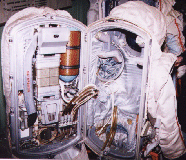 | Best shot of the set of the interior of the backpack life support system. |
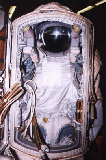 | What the cosmonaut saw as he was climbing into the suit. Note the 2 small, red oval shaped ducts to the lower right, probably part of the air circulating system. The holes for the arms and legs of the cosmonaut can be clearly seen. Another small, tan hole, between and slightly above the leg openings is visible. Given that the (male) cosmonaut was expected to be in the suit upwards of 48 hours, the meaning of this becomes evident. The tubes and fittings would have been connected and configured on board the LOK spacecraft in lunar orbit, with the help of the second member of the crew. |
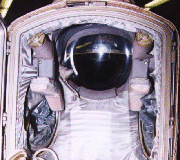 | Close-up from photo above, detailing the inside of the helmet and shoulder portions of the suit. Note the extensive padding around the shoulders as well as the chin pad inside the helmet. |
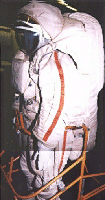 | Composite of two images from the left side 9 o’clock position. Note the 2 umbilicals near the glove of the suit which were probably to connect it to a recharging system for consumables such as oxygen, etc. |